
Why PAS 68 Still Matters
When it comes to creating safe and welcoming public spaces, getting the right level of protection in place is essential. Vehicle-related threats remain one of the biggest risks to people and property in busy urban environments. That’s where PAS 68 comes in.
PAS 68 is the UK’s benchmark for testing how well a product can stop a vehicle. It’s the standard that tells you, in measurable terms, what happens when a barrier, bollard or planter is put to the ultimate test. For specifiers, understanding what a PAS 68 rating means is key to making confident choices that balance performance, practicality and design.
This quick guide breaks down the essentials including what PAS 68 is, how it’s tested, and what to look for when selecting products for your next project.
What is PAS 68?
PAS 68 is short for Publicly Available Specification 68, and it’s the UK’s standard for testing and rating vehicle security barriers. Developed by the British Standards Institution (BSI), it sets out how products such as bollards, blockers, planters and street furniture should be tested to prove their ability to stop a moving vehicle.
PAS 68 provides a reliable way to measure real-world performance. It answers the critical question: “If a vehicle hits this barrier at a certain speed, will it stop it and how far will it go?”
The standard looks at factors such as vehicle size, speed, impact angle and how much the barrier moves or allows penetration on impact. The results are then recorded in a consistent format, which allows specifiers, designers and engineers to compare products accurately and make informed decisions.
It’s also worth noting that PAS 68 often works hand-in-hand with PAS 69, which gives guidance on how to install and position these barriers effectively. Together, they form the foundation of good Hostile Vehicle Mitigation (HVM) design.
Understanding the Test Format
Each rated product is subjected to a full-scale vehicle crash test to see exactly how it performs when struck. The results are then expressed in a standard format that captures key details about the test.
A typical PAS 68 rating might look something like this:
V/7500[N2]/80/90:0.0
At first glance, it can seem a bit technical, but once you know what each part means, it’s straightforward:
- V – Stands for “vehicle.” This tells you that a full vehicle test was used rather than a simulation.
- 7500[N2] – The weight and type of vehicle used. In this case, a 7,500 kg (7.5 tonne) medium goods vehicle.
- 80 – The speed at which the vehicle hit the product, in kilometres per hour.
- 90 – The angle of impact, in degrees (90° being a head-on collision).
- 0.0 – The distance the vehicle penetrated past the barrier, measured in metres.
In short, this code tells you that a 7.5 tonne vehicle travelling at 80 km/h, hitting the barrier head-on, was completely stopped with zero penetration.
These results give specifiers a clear and consistent way to assess performance. A lower penetration figure indicates a stronger result, but it’s also important to consider what’s practical for the site. Foundations, spacing, and intended use all play a part in selecting the right product.
Why PAS 68 Ratings Matter to Specifiers
Not all street furniture that looks tough can stand up to the kind of vehicle impact a PAS 68-rated product can handle. Having a clear PAS 68 rating means you know exactly how a product performs under real-world conditions. This helps specifiers:
Choose the right level of protection: Different projects face different risks. A busy city centre might need products rated to stop larger vehicles at higher speeds, while a quieter area might require less heavy-duty options.
Ensure compliance and reduce liability: Specifying PAS 68-rated products shows you’ve met industry standards and followed best practices, which is critical for safety and legal peace of mind.
Make informed budget decisions: Knowing the exact performance lets you weigh cost against protection, avoiding over- or under-specifying solutions.
Maintain design integrity: PAS 68 covers a wide range of products, so you can find tested options that fit your aesthetic and functional needs.
PAS 68 vs. IWA 14 vs. ISO 22343
PAS 68 is a UK-based standard created by the British Standards Institution (BSI) that tests hostile vehicle mitigation (HVM) products using full vehicle impacts as well as simulations or pendulum tests, designed around UK vehicle types and conditions. IWA 14‑1 is an international standard that builds on PAS 68 and the US ASTM F2656 standard, requiring only full vehicle crash tests and offering simplified, consistent reporting for easier global comparison.
Since 2023, ISO 22343-1 has been introduced, superseding both PAS 68 and IWA 14‑1 and creating a unified, internationally recognised standard for testing HVM products worldwide.
Integrating PAS 68 Products Into Design
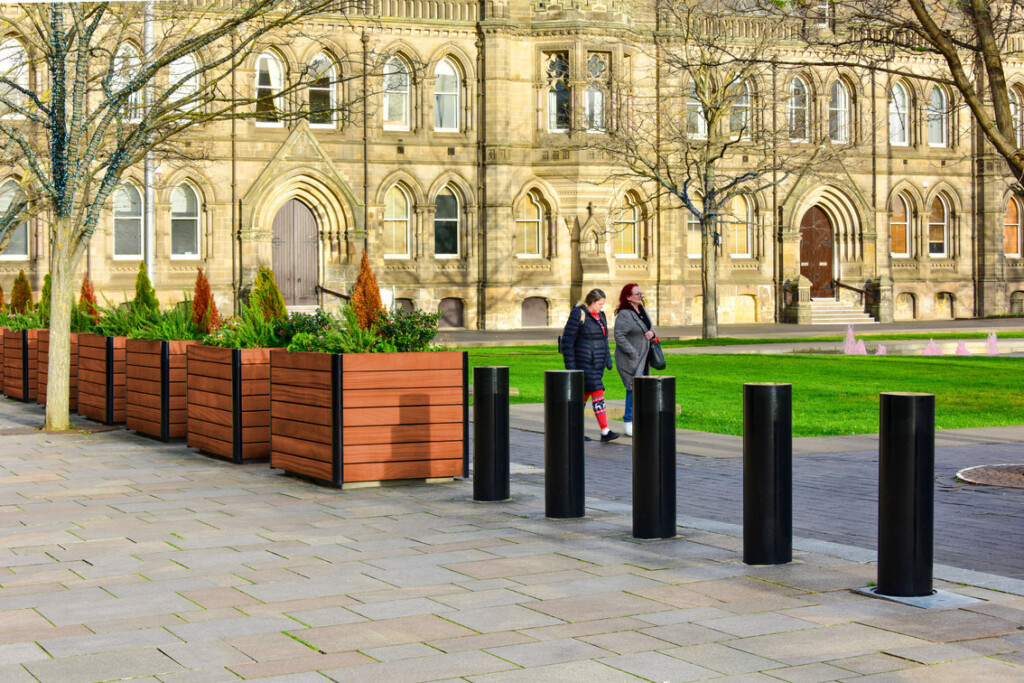
Safety doesn’t have to come at the expense of style. Modern PAS 68-rated products come in a variety of designs that blend and even enhance public spaces without looking like heavy security equipment. From elegant bollards to sturdy timber, it’s possible to provide strong vehicle protection while enhancing the overall streetscape.
Well-designed PAS 68 solutions can complement landscaping, support accessibility, and maintain pedestrian flow, all while delivering proven security.
At Townscape, we specialise in helping specifiers find the right balance between performance and aesthetics. Our range includes versatile, tested products that protect while giving you peace of mind and flexibility.
How Townscape Can Help You Specify with Confidence
Specifying PAS 68-rated products is a critical step in protecting people and places, but it doesn’t have to be complicated. With the right knowledge and trusted partners, you can confidently select solutions that meet your project’s safety, design, and practical needs.
At Townscape, our team of HVM product specialists are here to guide you through every stage, from understanding standards and performance ratings to choosing products that blend security with style.
If you’re planning a project that requires PAS 68-compliant protection, get in touch with us today on 01623 513355.
Let’s work together to create spaces that protect people and secure spaces.